
At its core, the BAG-INTEL project isn’t just about code and sensors, it is about the front-line reality of customs officers. The participation of end users, such as the Spanish Tax Agency (Agencia Estatal de Administración Tributaria – AEAT) is the vital bridge between advanced technological development and real-world operational experience. By bringing their airport expertise and risk-assessment capacity to the table, AEAT ensures that BAG-INTEL technology isn’t just a “lab experiment,” but a tool that responds to the high-stakes needs of airport security across Spain, Estonia, Denmark, Greece, and Italy.
Customs Controls
Working Customs at a Spanish airport means living in a state of constant flux. No two shifts are the same, and the day’s end rarely looks like its beginning. This environment demands rigor, lightning-fast responsiveness, and a commitment to continuous learning.
Different AEAT teams dedicate their commitment to ensuring that the project is not only successful but also becomes a useful, reliable tool aligned with European principles of security and respect for fundamental rights. Customs officers are the visible face of a complex, invisible chain. From the Border Radiological Control Department to the investigation and operations teams, these professionals protect the country against smuggling and illicit substances—all while ensuring the passenger flow remains undisturbed. It is a task as discreet as it is constant.
Silent Analysis
While maritime routes remain a primary concern, the sheer volume of international air travel represents an ongoing risk. Millions of passengers pass through Spanish controls each year, and hidden within that mountain of luggage are sophisticated attempts to circumvent security.
To meet this challenge, AEAT utilizes “Silent Analysis.” Non-intrusive inspection systems have evolved into discreet models where baggage is analyzed without the passenger even being aware of the process. True non-intrusive inspection happens behind the scenes; it is the analysis that takes place while the passenger moves freely, maintaining the rhythm of the airport.
And… Action!
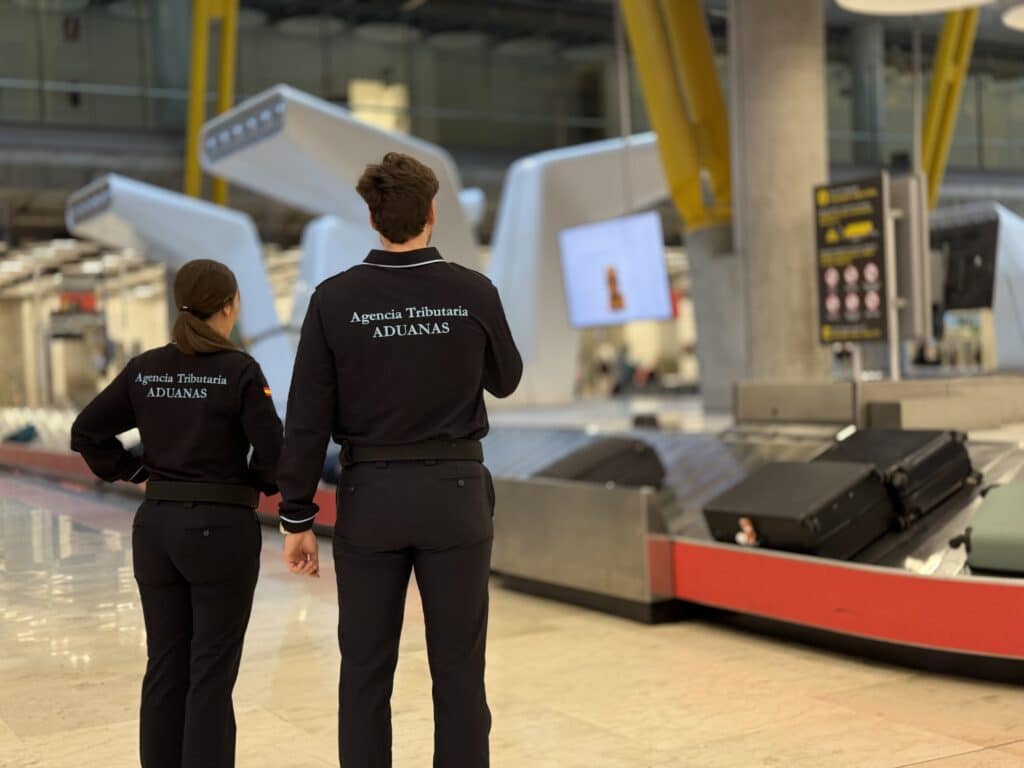
Once a potential risk is detected, the humans take over. Customs officers are deployed strategically at different points, from disembarkation to baggage claim. The strategy is never “automatic”; it is an art form that adapts to the context, the environment, and the specific information available. Each intervention is carried out with a dual focus: maintaining security and upholding the fundamental rights of every traveler.
BAG-INTEL Technology and Professional Judgment
In a high-pressure environment with limited resources, every decision must be justified. Physically inspecting a bag is an intrusive and operationally costly measure. This is where BAG-INTEL becomes a game-changer. Correct prioritization and optimization of resources are essential aspects that this technology will further strengthen.
By using data analysis to filter noise and identify patterns, the system acts as a trusted advisor, reinforcing the officer’s professional judgment rather than replacing it. The final decision remains human—informed by data, but driven by field experience and direct observation.
Looking Behind the Uniform
The work of the AEAT and, specifically, Customs, is rarely visible to travelers, yet its impact is real and constant. Behind every system, every tool, and every action, there are dedicated people who, through their daily work, ensure the security and integrity of the border control system in Spain.
By participating in the Horizon Europe program and specifically BAG-INTEL, AEAT is not just adopting new technology; they are helping build a future where borders are more efficient, resilient, and human-centric for everyone’s sake.