
Showcasing Versatility Across Different Airport Layouts
To demonstrate the social and technological impacts of the BAG-INTEL solution, the project has planned three use cases at three different European airports. These use cases highlight how the BAG-INTEL solution adapts to diverse layouts and baggage delivery infrastructures to ensure seamless integration and optimized customs operations.
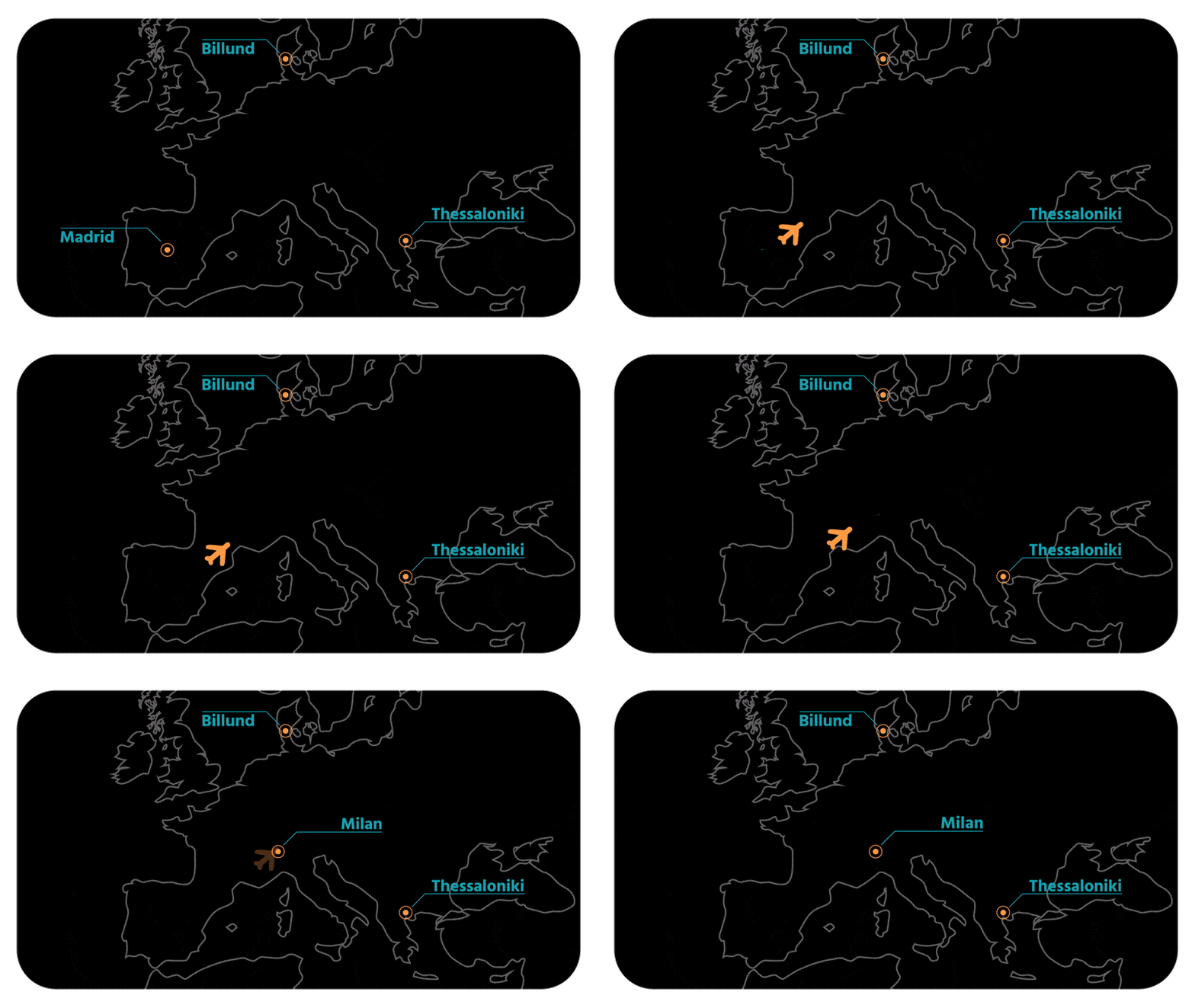
Use Case I: Billund Airport, Billund, Denmark

This use case will demonstrate the key capabilities of the BAG-INTEL system at Billund Airport in Billund, Denmark. In this use case, the application of the X-ray/CT scanner will be simulated. The use case will implement AI-powered risk analysis and visual tracking of luggage using cameras, enabling reidentification at the customs area at the exit of the baggage claim area. Additionally, the simulation will incorporate the application of sniffer dogs and the integration of external data, showcasing the system’s potential for enhancing operational efficiency and security.
Use Case II: Makedonia Airport, Thessaloniki, Greece

This use case will comprise the full demonstration of the BAG-INTEL system at Thessaloniki “MAKEDONIA” Airport (SKG), in Greece. The demonstration will include the physical installation of an X-ray/CT scanner and the deployment of multiple cameras that support the re-identification system. Furthermore, in this use case, the physical presence of a bag tag reader will contribute to the luggage risk assessment and consequently to the customs agents/police officers decision support tool. The use case will also be supported by a visualization and simulation model of the BAG-INTEL system through a digital twin, designed to provide the concept of the whole procedure and the airport itself. As part of the demonstration, this use case will also consider its integrability with any related systems already deployed by the airport, the customs, and the police, including the application of sniffer dogs and intelligence information systems.
Use Case III: Milan Linate Airport, Milan, Italy (previously located at Adolfo Suárez Madrid-Barajas Airport*, Madrid, Spain)

This use case comprises a setup of the full BAG-INTEL system at the Milan Linate Airport in Italy. The project will leverage an existing X-ray/CT scanner and integrate AI-powered cameras for advanced luggage tracking, including reidentification at the customs area near the baggage claim exit. Initially, this use case will be based on a non-integrated scanner/handling system, demonstrating the versatility and effectiveness of the BAG-INTEL solution across different airport layouts. In a fully operational phase, additional components, such as sniffer dogs and the integration of external data sources, may be implemented to further enhance system capabilities. The BAG-INTEL system is expected to be operational during the Milano Cortina 2026 Olympic Winter Games, a period expected to see a significant increase in passenger traffic.
*In the first half of the project, Use Case III was located at Adolfo Suárez Madrid-Barajas Airport. The use case site has been relocated to Milan Linate Airport for the second half of the project to demonstrate the system’s adaptability to diverse airport layouts and operational challenges.
Summary
The three use cases demonstrate BAG-INTEL’s ability to adapt to diverse airport layouts and baggage delivery infrastructures. Whether managing extended baggage pathways or accommodating space-constrained environments, the system showcases its flexibility, integrability, and potential to enhance customs operations across various layout scenarios encountered at European airports.
Training for end users
To ensure seamless adoption of the BAG-INTEL solution, the consortium will develop training materials for end users based on co-design principles. These materials aim to familiarize airport personnel and security practitioners with the BAG-INTEL platform, supporting its effective implementation and operation. The training will include workshops and supporting multimedia materials, enabling end users to effectively integrate and leverage the platform’s capabilities in real-world operations.